



Author: Luan Khanh – Master of Information Technology, General Director of SpeedUP Technologies Vietnam
Luan Khanh is the Founder & CEO of SpeedUP Technologies Vietnam, a technology enterprise established in 2007, specializing in providing Speed POS solutions, payment gateways, business automation and artificial intelligence applications.
He graduated with a Bachelor of Computer Science majoring in Artificial Intelligence and a Master of Computer Science at the University of Natural Sciences, National University of Ho Chi Minh City. Ho Chi Minh, with the research direction of Rough Set Theory and Data Mining.
With more than 25 years of experience in the field of enterprise technology, he focuses on the fields of Enterprise AI, Knowledge Transformation, Retail Automation, Digital Payment and Immersion Cooling for AI infrastructure. He currently leads SpeedUP to develop AI Agent and AI Tank platforms, aiming to build a generation of smart businesses in the AI era.
When the question is no longer “Can AI write the source code or not?”
In more than half a century of development, the software industry has undergone many important transformations. We go from programming on single computer systems to the Internet; from sequential development model to Agile; from enterprise-based infrastructure to cloud computing; from months-long software releases to continuous integration and deployment; from centralized systems to modern distributed service architecture and cloud computing. Each transformation makes software development faster, more flexible and has better scalability. But there is one basic thing that is almost unchanged: “People are the center of the process of transforming an idea into software.”
That process is carried out:
Artificial intelligence (AI) is starting to change this very structure. So, the big question of the software industry: “What will happen when AI can participate in almost the entire transition from a business idea to a operable software system?”
This is not just a story about programming productivity. This could be a fundamental change in software production methods.
Traditional software engineering: a system of human knowledge conversion
A traditional business software project often has to go through a long chain:
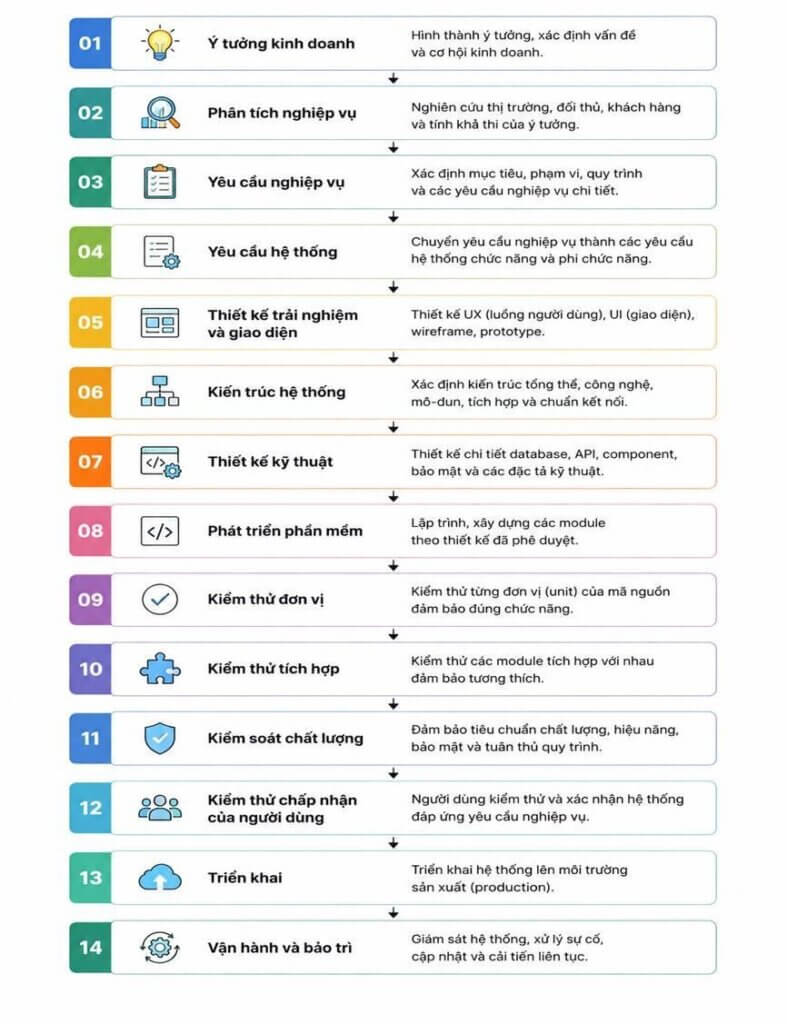
In the software major, this entire chain is often called the software development life cycle – Software Development Life Cycle (SDLC). But if we look at it from the perspective of knowledge, we will see a different structure, which is actually a chain of knowledge transformation – Knowledge Transformation according to the steps:
Every time knowledge is converted, it costs money, and more importantly, every conversion has the potential to create information loss as follows:
Therefore, the final product does not always fully reflect the original intention. This phenomenon can be described in a general way:
Business intention ≠ Requirements ≠ Design ≠ Source code ≠ Final product
This is a long-standing structural limit of the software industry. As the number of transfer floors increases, the coordination cost, the risk of requirement deviation and the delay between business demand and the final product also increase. For large-scale enterprise systems such as ERP or CRM, this challenge is even more obvious due to the complexity of process, integration and management changes.
Software was born for automation. But in many businesses, the process of creating software itself relies heavily on manual coordination between people.
When a business requirement changes, even if it is sometimes just a small change, it can lead to the simultaneous updating of documents, interfaces, architectures, source code, test scripts and documentation. Agile has helped the software industry reduce the scale of each development cycle and increase adaptability. DevOps continues to reduce the gap between development and operation. Cloud computing significantly reduces infrastructure preparation time. But most of these improvements still focus on optimizing each stage of the process.
The AI era poses another possibility: Instead of just making each step faster, can we shorten, merge or eliminate some intermediate steps?
This is the fundamental difference that affects the Software Engineering industry.
A popular view today is to see AI as a programming assistant (AI Assistant). That view is correct, but not enough. generative AI can now participate in many different activities:
If these capabilities are connected together, AI is no longer merely a coding support tool. AI begins to become a class of knowledge transformation between human intent and software systems. Can be imagined:
Human intention
↓
Professional knowledge and specialized knowledge
↓
↓
Requirements + Architecture + Interface + Source code + Testing + Document
↓
Human appraisal and management
↓
Software capable of operating
From there comes an important thesis: The long-term value of AI for the software industry may not lie mainly in the ability to create source code, but in the ability to compress the process of knowledge transformation. This phenomenon can be called “knowledge compression” – Knowledge Compression. AI helps reduce the number of intermediate layers that knowledge must go through before becoming an execible system.
This change is not only based on prediction. The Artificial Intelligence Index Report 2025 of Stanford University’s Human-Centered Artificial Intelligence Institute recorded very rapid progress on SWE-bench, a set of assessments built from real-world software engineering problems. According to the report, in 2023, AI systems can only solve about 4.4% of the problems in SWE-bench. By 2024, this rate has increased to 71.7%. What is worth paying attention to is the rate of improvement of this capacity. A very limited possibility in a year can become significant after a short time. Therefore, businesses should not build software development strategies based on the assumption that the capacity of AI today will remain the same in the next three or five years.
This is a point that needs to be especially cautious if you want to look at the problem from a scientific perspective. The study of Sida Peng and colleagues, published in 2023, conducted a controlled experiment to assess the impact of GitHub Copilot on programming productivity. In that experiment, the group of programmers who were allowed to use the AI tool completed a task of building an HTTP server using JavaScript about 55.8% faster than the group that did not use the tool. This is an important empirical proof, but it is necessary to properly understand the scope of the results, and it does not mean that: “a two-year project will automatically be reduced to one year.” The productivity of a programming task and the productivity of an entire software project are two different concepts. A business project also includes understanding requirements, decision-making, system integration, information security, testing, change management, approval, legal and many other factors. Therefore, when evaluating AI, it is necessary to distinguish: productivity at the work level from the productivity of the entire software engineering system.
Another remarkable study by the METR organization in 2025 showed almost the opposite result.
METR conducted a randomized controlled trial – Randomized Controlled Trial (RCT) with 16 experienced open source programmers, performing 246 tasks on the same code stores that they are familiar with. The results show that when allowed to use AI tools in early 2025, this group of programmers took about 19% longer to complete the work. This does not prove that AI generally reduces productivity. The research subjects are very experienced programmers, working on systems that they have a deep understanding. The sample size is also relatively small. But this study proves an important thing: Productivity generated by AI is not a constant. It depends on: type of work + user capacity + level of system understanding + quality of AI tools + technical process + complexity of the software.
Notably, in the 2026 update, METR said that new experiments began to show signs that AI could generate acceleration, but statistical uncertainty was still significant. This reflects a very important feature of the current field: we are studying a constantly changing subject.
AI capabilities are progressing so fast that a study today’s results may need to be re-evaluated after just one or two years.
One of the most valuable studies to understand AI in the software industry comes from Google’s DORA research program. The DORA 2025 State of AI-assisted Software Development report is built on more than 100 hours of qualitative research and surveying nearly 5,000 technology experts around the world. One of the important conclusions of the study is: AI works like an amplifier. It amplifys the inherent capacity of the organization.
A business has:
can be amplified by AI into a very powerful industrial organization.
On the contrary, an organization has:
can also be helped by AI to create chaos faster.
DORA describes AI exactly in this direction: AI highlights and amplifies both the strengths and problems of the organization. This is a very important principle: AI does not automatically turn a weak software development organization into a strong one. It makes the organization’s inherent capacity, technical culture and management quality more clearly and faster.
One of the most realistic changes will happen at the beginning of the software life cycle.
Previous: Idea → Requirement → Design → Prototype (sample) → Product
In the model with AI support: Idea → Prototype → Appraisal → Product
This reversal is very important. Imagine a retail business that wants to build a smart store. The person in charge of the product said: “I want customers to walk into the supermarket, find products in natural language, be guided by the system to the right location, self-scan the product and pay without going through the cashier.”
AI can turn that idea into a software prototype:
– customer journey;
– screen stream;
– sample interface;
– professional rules;
– data model;
– integrated interface;
– and even a part of the system is capable of working.
The person in charge experienced it directly and then responded: “The payment process is still too complicated.”
The system is adjusted. “The promotion should appear when customers approach the goods area.”
Business rules are updated.
In this model, the prototype is no longer just the result of the required document. Prototype becomes a tool to discover requirements. This is a profound change in the way we create software insights.
Old model: Understanding → Writing documents → Building
New model: Think → Try → Experience → Learn → Adjust
Or in other words: We don’t just understand and then build; we build to understand more deeply.
When the request, prototype, source code, test and documentation are all supported by AI, an important consequence is that the development time is likely to be significantly shortened. This phenomenon can be called: Software Time Compression (Software Time Compression)
However, it is necessary to avoid a simple conclusion that every two-year project can be reduced to three months. Banking, aviation, health, payment, government or critical infrastructure systems still need to:
But if AI can reduce the time of many stages in the software life cycle, the first thing that changes is not just the time to bring the product to the market. More importantly, the time to learn the business is reduced, and the generality of software, and product quality is closer to actual requirements to help businesses:
This is the profound economic value of shortening the software industry cycle in this era!
AI creates a new paradox, as it becomes easier to generate source code: The cost of creating software decreases, the volume of software that an organization can create also increases. But at the same time, businesses have to answer more and more questions:
Therefore: The cost of creation decreases but the importance of testing and verification increases. This can become a core principle of software industry in the AI era. In the past, the value of engineers was much in the ability to create. In the future, an increasing part of the value will lie in the ability to determine what is true, safe and reliable.
If AI has the ability to create more and more source code, a natural question arises: What will software engineers do? The answer may not be that the engineer disappeared. Their value will shift as follows:
An engineer in the future may not directly write the entire source code. They can coordinate many specialized AI agents:
People stand on a higher level to determine: goals + context + architecture + limits + quality standards + responsibility. AI does more and more parts of the transition in between. The new role can be described in scientific terms: AI Engineering Orchestrator – AI industry coordinator. That does not reduce the role of the engineer, on the contrary, it requires higher competence in system thinking, architecture, professional understanding and evaluation ability.
When specialized AI agents are connected into a unified platform, a new model can appear AI Software Factory Model in the following direction:
1. Business intention
2. Business knowledge class
3. Request analysis agent
4. Architectural agent
5. Experience design agent
6. Development agents
7. Test agent
8. Information security agent
9. Deployment and operation agent
10. Human management and appraisal
11. Practical operation system
12. Activity data
13. New knowledge
14. Continuous improvement
The most important point of this architecture is not the number of AI agents. That is: KNOWLEDGE CLASS
If AI doesn’t understand:
then AI can only create universal software. Therefore, an AI software company cannot only be built with a large language model. It needs a combination of: AI Model + Enterprise Knowledge + Technical Platform + Management + Human Expert.
Looking back at the model of Software Engineering:
AI can add a new cycle: THINK → CREATE → VERIFY → OPERATE → LEARN.
THINKING: Humans define problems, goals, contexts and limits.
CREATION: AI converts knowledge into prototypes, architecture, source code, testing and documents.
VERIFICATION: Humans and AI evaluate functionality, safety, performance, architecture and compliance.
OPERATION: The system is put into the actual environment and observed continuously.
LEARNING: Operating data, user behavior and feedback become knowledge for the next cycle.
This is no longer just a software development life cycle. It is closer to: Knowledge Transformation Lifecycle
For decades, source code has been considered one of the most important intellectual assets of software businesses. But let’s ask a question: If source code is getting easier to create, what will become scarce? Maybe the answer is: KNOWLEDGE
AI models can be approached by many businesses. Computing infrastructure can be rented. Source code can increasingly be created automatically. But the specialized knowledge accumulated in 10 or 20 years of operation is not easy to copy. Therefore, the competitive advantage can shift from:
Own the source code
↓
Own data and knowledge
↓
Ability to convert knowledge into products
This may be one of the most important strategic changes for software technology businesses in the AI era.
It is possible to imagine a business operated according to the AI model as a rotation:
KNOWLEDGE
↓
WHO
↓
Software
↓
BUSINESS ACTIVITIES
↓
DATA
↓
NEW KNOWLEDGE
↓
WHO
↓
BETTER SOFTWARE
In technology management research, this structure can be called a knowledge wheel – Knowledge Flywheel. The more software is used, the more operational data businesses collect.
Therefore, the future competition may no longer be: Who has the most programmers? Which is: Who can convert knowledge into business value the fastest?
The AI era, this is not only the story of technology corporations in the United States, China, India, it has a special meaning for ASEAN. For decades, part of the advantage of the software industry in emerging economies has come from the difference in human resource costs. International businesses can build a team of dozens or hundreds of engineers in a country with a lower cost. AI began to put pressure on this model. If a small group of highly qualified engineers, with deep specialized knowledge and enhanced by AI can create the capacity that previously needed a large team, the competitive advantage is no longer simple: Cost per engineer. It will turn into:
And finally: Business value generated per unit of time. This is a particularly remarkable change for countries with a developed outsourcing industry.
AI not only affects programmers. When AI systems are capable of creating content, analyzing data, supporting decision-making and automating knowledge work, the impact will spread to many other sectors of the economy. Therefore, the important issue for ASEAN should not only be placed in the form of: how many jobs will AI replace? A more meaningful question is:
This is not only the problem of software technology enterprises, but also the problem of education, labor policy, research capacity and national development strategy.
In the long term, AI can help ASEAN economies overcome some levels of development faster. Traditional model:
Low-cost manpower
↓
Software outsourcing
↓
Software engineering service
The new model should be aimed at:
Industry is enhanced by AI
↓
Specialized solution
↓
Products
↓
Platform
↓
Intellectual property
↓
Regional and global technology enterprises
In the traditional software world, building a global technology product requires a huge amount of capital, manpower and time. If AI reduces:
then the innovation barrier is also reduced. A Vietnamese business can test many ideas instead of just one. An ASEAN startup can build a prototype in a few weeks instead of a few months. A corporation can convert its accumulated knowledge into digital products faster than before. It is a much greater economic impact than the story of saving a few hours of programming.
If you look at the deeper level, the software industry is likely to change from: Process-Driven Engineering to: Intent-Driven Engineering.
In the old model, people had to identify and perform a long series of steps. In the new model, people are increasingly focusing on the questions:
AI will do more and more parts of the question: How to build it? This may be the most profound philosophical change of the software industry in the AI era.
The application of AI can significantly shorten the distance from idea to prototype and product, but this speed also creates a new risk layer.
Therefore, the more AI reduces the cost of creating software, the role of verification, architecture, security, governance and human responsibility must increase. The goal of the software industry in the AI era is not to remove humans from the process, but to shift the human role from the one who directly creates all the components to the person who directs, verifies and is responsible for the entire system.
AI will not end the software industry. But AI could end a period when much of the value of software engineering lies in the fact that humans constantly transfer information from one form to another. The ongoing shift:
And for Vietnam as well as ASEAN: From labor advantage → Knowledge advantage
If we had to condense the AI revolution in software technology into one concept, it might not be: the ability to create source code. But: DISTANCE FROM IDEA TO REALITY. For decades, the gap between a business idea and a operating system was measured in years, then months. AI is making it possible to bring that gap down to a few months, a few weeks – and for the prototype, in some cases only a few days. As this distance decreases, a larger chain of impacts appears:
The cost of testing is reduced
↓
Businesses can try more ideas
↓
Increased learning speed
↓
Faster innovation cycle
↓
The time to put products on the market is reduced
↓
Increased competitiveness
Therefore: AI not only makes software technology faster. AI is reducing the economic cost of turning an idea into reality.
That may be the deepest impact. And the strategic question for the Vietnamese and ASEAN technology industry should no longer be: “How many percent of the source code can AI write?” but should be: “When AI can transform knowledge into software capable of operating at an unprecedented speed, how will we reorganize the business, retrain engineers and build national technology capacity?”
The country that answers that question soon will not only own a more effective software industry. They can build a new innovation engine for the entire economy.
1. DeBellis, D., Storer, K., Harvey, N. et al. (2025). DORA 2025 State of AI-assisted Software Development ReportGoogle/DORA The study is based on more than 100 hours of qualitative data and a survey of nearly 5,000 technology experts; emphasizing the role of AI as an amplifier of organizational capacity and weaknesses.
2. Peng, S. et al. (2023). The Impact of AI on Developer Productivity: Evidence from GitHub Copilot. The controlled experimental study showed that the team using GitHub Copilot completed the programming task in the experiment 55.8% faster.
3. Becker, J. et al. / METR (2025). Measuring the Impact of Early-2025 AI on Experienced Open-Source Developer Productivity. Randomized controlled trials show that under specific research conditions, the experienced group of open source programmers took about 19% longer when using AI tools.
4. METR (2026) Developer Productivity Experiment Update The follow-up study noted signals that the productivity impact of AI is changing as technology advances, but statistical uncertainty is still significant.
5. Stanford Institute for Human-Centered Artificial Intelligence (2025). Artificial Intelligence Index Report 2025The report recorded that the capacity of AI systems on SWE-bench increased from 4.4% in 2023 to 71.7% in 2024.
6. Storer, K. and D. Debellis (2025). DORA AI Capabilities Model Research shows that the effectiveness of using AI depends heavily on the technical background, working environment and organizational capacity, rather than just relying on the AI tool itself.
To describe the transformation of software technology in the AI era, the article uses the following concepts, which have recently been used when presenting AI:
1. Knowledge Transformation – Knowledge Transformation
Software technology is seen as the process of transforming business knowledge and specialized knowledge into an enforceable system.
2. Knowledge Compression – Knowledge Compression
AI reduces the number of intermediate layers needed to transfer knowledge into software.
3. Software Time Compression – Software Time Compression
The development cycle has the ability to move from year to month; the prototype creation cycle from month to week or day.
4. AI Software Factory model – AI Software Factory
Human, business knowledge and specialized AI agents operate on a unified technical platform.
5. Knowledge wheel – Knowledge Flywheel
Software creates data; data creates knowledge; knowledge helps AI create better software; better software continues to create more data and knowledge.
6. Intent-Driven Engineering
Humans shift the focus from describing each step of implementation to determining intentions, goals, contexts, limits, architecture and responsibilities.
These six concepts can be condensed into one thesis: The future of software engineering does not lie in creating more source code, but in the ability to transform knowledge into reliable systems – faster, more continuous and on a larger scale.
